
Page last updated on February 20, 2026 at 8:28 am
About the Bloomington Rail Trail
Bloomington Rail Trail - Southern Meadows Spur
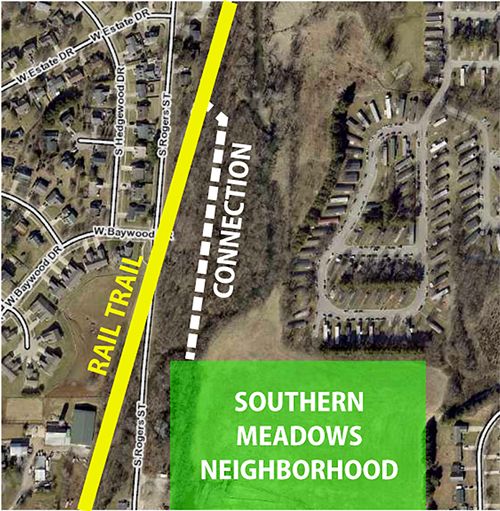
- At their regular meeting on Aug. 29, 2023, the Board of Park Commissioners approved an encroachment from Wininger Construction, the developers of the new Southern Meadows neighborhood, to develop a trail spur that will connect the neighborhood to the Rail Trail.
- This encroachment agreement allowed the developer to build a soft-surface trail connection to the Bloomington Rail Trail along a parallel abandoned railway bed. The connection is approximately 900 feet long.
- See the notes from the August 29, 2023 meeting of the Board of Park Commissioners
Bloomington Rail Trail Description
- The Bloomington Rail Trail is a two-mile, gravel surface trail that connects with the Clear Creek Trail north of the Clear Creek Trail's Church Lane Trailhead and Country Club Drive (directly south and connecting to the B-Line Trail extending through Switchyard Park).
- Learn more about the Clear Creek Trail.
- Learn more about the B-Line Trail.
- Learn more about Switchyard Park.
There are two benches along the trail and a seasonal drinking fountain with a dog bowl at Country Club Drive. A garbage receptacle is located near the parking area.
The Bloomington Rail Trail served as a corridor for railroad operations for a series of companies including the New Albany and Salem Railroad, the Monon Railroad, and eventually CSX Railroad. CSX Railroad made the decision to phase out its services in 2000, and the last train left McDoel Switchyard—now Switchyard Park—in 2004.
In keeping with its transportation history, the Bloomington Rail Trail still serves as an important corridor for biking, foot traffic, recreation, and wildlife.
The terrain along the Bloomington Rail Trail can be described as an early successional-greenspace that offers vertical wildlife habitat. Succession is the term used to describe the natural ecosystem change that takes place over time.
The Bloomington Rail Trail fits within the mosaic pattern of both old and dark habitat forests on the edges of Bloomington. This younger vertical habitat corridor provides cover, food and sunlight for birds traveling between the older and darker Morgan and Monroe forests. Water is naturally present along both sides of the trail. The creek and seasonal ponds add food and a life force that supports a sustainable habitat for various animals and key native plant species.
The Bloomington Rail Trail is a well known hotspot for 74 bird species documented through ebird.org.
- Visit ebird.org, a project of the Cornell Lab of Ornithology, for more information about ebird (external website).
Notable birds include species like indigo bunting who love railroad corridors and edges, and screech owls, bluebirds and pileated woodpeckers, who rely on nesting in cavities of dead and standing-trees to complete their life cycle.
Parks and Recreation is committed to adhering to the City of Bloomington Climate Action Plan. This involves managing large-scale infestations of multiple invasive plant species via different treatment approaches over several years. Once populations are under control, annual monitoring and maintenance are essential to prevent reinfestation.
This process of controlling invasive species allows native plant species to thrive, in turn supporting biodiversity through conservation, enhancement, and expansion of greenspace in Bloomington. The City of Bloomington Environmental Commission's Bloomington Habitat Connectivity Plan (2017) strives to increase existing greenspace to foster a healthy and stable ecosystem.
City Park Property Rules, and Removal or Suspension from Park Property
Property rules and hours of operation, actions that could result in removal, and the appeal process.
Special Events or Filming in City Parks and Trails
Special permission is required to hold a special event on a city trail, or to conduct commercial filming on city property.
Chemical Applications in City Parks
A record of chemical applications in city parks and trails.
Report a Problem on the Bloomington Rail Trail
Use the uReport online system to report a problem or make a comment.